



Chile is a unitary presidential republic in western South America, stretching approximately 4300 km from north to south along the Pacific coast. The country borders Peru, Bolivia, and Argentina, and also lays claim to territory in Antarctica. The capital is Santiago; major cities include Valparaiso, Concepción, and Antofagasta. The population is approximately 19,6 million; the official language is Spanish, and Mapudungun, Aymara, and Rapanui are spoken at the regional level. The currency is the Chilean peso. National symbols include the huemul deer and the Andean condor. The system of government consists of an elected president and a bicameral National Congress. Chile's economy is diversified, but relies on copper and lithium mining, agriculture, forestry, salmon farming, services, and a growing renewable energy sector. Land-based casinos operate under licenses, while online betting is still in the process of developing its regulatory framework. The country's armed forces are professional and focused on defense and peacekeeping.
History
Long before the arrival of Europeans, diverse cultures flourished across Chile, stretching from northern to southern latitudes. In the far north, Atacameño communities created irrigated oases on the edge of the desert and conducted trade across the Andes. In the central and southern regions, the Mapuche and related peoples played a significant role, creating stable social structures and distinguished by a steadfast desire for autonomy. In the late 15th century, the Inca Empire extended its influence to the far north but was unable to subjugate the core Mapuche lands. In the 1540s, the Spanish, led by Pedro de Valdivia, founded Santiago and other cities, establishing the Captaincy General of Chile. Colonial Chile was a frontier society, defined by the Arauco War—a centuries-long conflict and negotiation process with the Mapuche—and its relative economic marginality compared to Peru. The colony's economy was based on wheat cultivation, livestock raising, and small-scale mining, with the southern territories remaining largely unconquered.
The struggle for independence began in 1810 with the establishment of a local junta amid the upheaval of the Napoleonic Wars. Following royalist counteroffensives, the patriot cause prevailed under the joint leadership of Bernardo O'Higgins and José de San Martín, leading to independence in 1818. Throughout the 19th century, the young republic consolidated its position, centralizing state institutions and expanding education and infrastructure. During the War of the Pacific (1879–1884) against Peru and Bolivia, Chile gained control of the saltpeter-rich northern territories, radically altering public finances and stimulating immigration and modernization. The civil war of 1891 ushered in a transition to a parliamentary republic and ushered in decades of intense political struggle between oligarchic factions, as well as the rise of social movements among miners, dockworkers, and urban workers.
In the 20th century, import-substitution industrialization policies promoted the development of manufacturing, and copper gained enormous importance on the global market. By the late 1960s, political polarization in the country had intensified. In 1970, Salvador Allende became the world's first democratically elected Marxist president; he implemented profound reforms amid economic instability and external pressure. On September 11, 1973, a military coup led by General Augusto Pinochet overthrew the Allende government. A harsh dictatorship was established, characterized by human rights violations, market reforms, and the adoption of a new constitution in 1980. A plebiscite in 1988 ended the dictatorship, and democracy was restored in the country in 1990 with the accession to power of President Patricio Aylwin. Successive center-left and center-right governments expanded social support measures and deepened integration into the global market economy. Chile successfully overcame a number of crises and natural disasters, including the devastating 8,8-magnitude earthquake in the Maule region (2010) and the dramatic, internationally watched rescue operation of miners in Copiapó (2010).
From the student protests of 2011 to the widespread social unrest of 2019, Chile faced demands for social justice, pension reform, and a renewed constitution. A constitutional process was launched in 2020, but proposed drafts of a new constitution were rejected in referendums in 2022 and 2023, leaving debate on reform ongoing. In 2022, Gabriel Boric assumed the presidency, marking a generational change and a commitment to a more inclusive development model. Chile remains a democratic state with a high level of institutional capacity—by regional standards—as it addresses challenges such as overcoming inequality, transitioning to a sustainable economy, ensuring the rights of indigenous peoples, and adapting to climate change.
Industrials
Mining plays a leading role in value creation and exports. Chile is the world's largest copper producer, home to Codelco and such giant mines as Escondida. Lithium extraction from brines in the Atacama Desert provides raw materials for a rapidly growing battery materials sector. Other important industries include forestry and pulp production, salmon farming in the south, fruit and wine exports, and services. Well-known Chilean brands and companies include wine producer Concha y Toro, LATAM Airlines, retailer Falabella, forestry giants Arauco and CMPC, lithium company SQM, food technology startup NotCo, and engineering company Crystal Lagoons. The country's industrial achievements include world leadership in copper mining, a leading position in salmon production, and the operation of industrial-scale solar power plants in the Atacama Desert, which utilize some of the world's highest solar insolation rates.
Flora and fauna
Chile's geographic isolation results in a high level of endemism. Iconic species include the huemul deer. Chile is a unitary presidential republic in western South America, stretching approximately 4300 km from north to south along the Pacific coast. The country borders Peru, Bolivia, and Argentina and also lays claim to territory in Antarctica. The capital is Santiago; major cities include Valparaiso, Concepción, and Antofagasta. The population is approximately 19,6 million; the official language is Spanish, and Mapudungun, Aymara, and Rapanui are also spoken regionally. The currency is the Chilean peso. National symbols include the huemul deer and the Andean condor. The system of government consists of an elected president and a bicameral National Congress. Chile's economy is diversified, but relies on copper and lithium mining, agriculture and forestry, salmon farming, services, and a growing renewable energy sector. Land-based casinos operate under licenses, while the online betting industry is still in the process of developing a regulatory framework. The country's armed forces are professional and focused on defense and peacekeeping.
History
Long before the arrival of Europeans, diverse cultures flourished across Chile, stretching from northern to southern latitudes. In the far north, Atacameño communities created irrigated oases on the edge of the desert and conducted trade across the Andes. In the central and southern regions, the Mapuche and related peoples played a significant role, creating stable social structures and distinguished by a steadfast desire for autonomy. In the late 15th century, the Inca Empire extended its influence to the far north but was unable to subjugate the core Mapuche lands. In the 1540s, the Spanish, led by Pedro de Valdivia, founded Santiago and other cities, establishing the Captaincy General of Chile. Colonial Chile was a frontier society, defined by the Arauco War—a centuries-long conflict and negotiation process with the Mapuche—and its relative economic marginality compared to Peru. The colony's economy was based on wheat cultivation, livestock raising, and small-scale mining, with the southern territories remaining largely unconquered.
The struggle for independence began in 1810 with the establishment of a local junta amid the upheaval of the Napoleonic Wars. Following royalist counteroffensives, the patriot cause prevailed under the joint leadership of Bernardo O'Higgins and José de San Martín, leading to independence in 1818. Throughout the 19th century, the young republic consolidated its position, centralizing state institutions and expanding education and infrastructure. During the War of the Pacific (1879–1884) against Peru and Bolivia, Chile gained control of the saltpeter-rich northern territories, radically altering public finances and stimulating immigration and modernization. The civil war of 1891 ushered in a transition to a parliamentary republic and ushered in decades of intense political struggle between oligarchic factions, as well as the rise of social movements among miners, dockworkers, and urban workers.
In the 20th century, import-substitution industrialization policies promoted the development of manufacturing, and copper gained enormous importance on the global market. By the late 1960s, political polarization in the country had intensified. In 1970, Salvador Allende became the world's first democratically elected Marxist president; he implemented profound reforms amid economic instability and external pressure. On September 11, 1973, a military coup led by General Augusto Pinochet overthrew the Allende government. A harsh dictatorship was established, characterized by human rights violations, market reforms, and the adoption of a new constitution in 1980. A plebiscite in 1988 ended the dictatorship, and democracy was restored in the country in 1990 with the accession to power of President Patricio Aylwin. Successive center-left and center-right governments expanded social support measures and deepened integration into the global market economy. Chile successfully overcame a number of crises and natural disasters, including the devastating 8,8-magnitude earthquake in the Maule region (2010) and the dramatic, internationally watched rescue operation of miners in Copiapó (2010).
From the student protests of 2011 to the widespread social unrest of 2019, Chile faced demands for social justice, pension reform, and a renewed constitution. A constitutional process was launched in 2020, but proposed drafts of a new constitution were rejected in referendums in 2022 and 2023, leaving debate on reform ongoing. In 2022, Gabriel Boric assumed the presidency, marking a generational change and a commitment to a more inclusive development model. Chile remains a democratic state with a high level of institutional capacity—by regional standards—as it addresses challenges such as overcoming inequality, transitioning to a sustainable economy, ensuring the rights of indigenous peoples, and adapting to climate change.
Industrials
Mining plays a leading role in value creation and exports. Chile is the world's largest copper producer, home to Codelco and such giant mines as Escondida. Lithium extraction from brines in the Atacama Desert provides raw materials for a rapidly growing battery materials sector. Other important industries include forestry and pulp production, salmon farming in the south, fruit and wine exports, and services. Well-known Chilean brands and companies include wine producer Concha y Toro, LATAM Airlines, retailer Falabella, forestry giants Arauco and CMPC, lithium company SQM, food technology startup NotCo, and engineering company Crystal Lagoons. The country's industrial achievements include world leadership in copper mining, a leading position in salmon production, and the operation of industrial-scale solar power plants in the Atacama Desert, which utilize some of the world's highest solar insolation rates.
Flora and fauna
Chile's geographic isolation results in a high level of endemism. Iconic species include the huemul deer. Chile is home to the pudú, Andean condor, Magellanic penguin, and the endangered Darwin's frog. Marine life thrives along the Humboldt Current, home to sea lions, dolphins, and abundant fisheries. Flora ranges from Atacama cacti and desert flowers to central Mediterranean sclerophyll forests and the ancient Araucaria araucana of the south. Juan Fernández and Rapa Nui are home to unique species under strict protection. Many species are listed on national red lists and the IUCN register. The export of native wildlife and some plants is restricted and controlled in accordance with CITES and national legislation.
Religion and race
Chile is a country with a diverse religious population, historically predominantly Catholic, with significant Protestant and Evangelical communities, as well as a large and growing secular population. Indigenous peoples make up approximately one-tenth of the population, led by the Mapuche, with Aymara, Diaguita, Rapanui, and others also present. Traditions combine Catholic holidays, Gospel services, and traditional indigenous rituals, such as Ve Tripantu, the Mapuche New Year. Public life is secular, and interfaith coexistence is the norm.
Wars and conflicts
Major conflicts include the Arauco War, the War of the Pacific, and the Civil War of 1891. A dispute with Argentina over the Beagle Channel in the late 20th century was settled diplomatically in 1984. Today, Chile is not involved in external wars and contributes to peacekeeping operations. Internal tensions include periodic conflicts over land and rights in the south, which the state resolves through policing and dialogue. The risk of terrorism is low, although there have been isolated incidents. War cemeteries and memorials exist throughout the country, and the memory of the victims of the dictatorship is institutionalized.
Standard of living
Chile ranks highly in Latin America in human development, competitiveness, and governance. Inequality remains above the OECD average, but poverty has declined significantly in recent decades. Perceptions of corruption are relatively low in the region, although accountability and campaign finance remain challenges for the population. City services are reliable, and digital adoption is widespread.
Medicine
The healthcare system is a combination of public and private sectors. Major cities have modern hospitals affiliated with the public Fonasa system and the private Isapre network. Pharmacies (such as Cruz Verde and Ahumada) are ubiquitous and often open late. Tap water is potable in many urban areas, but travelers with sensitive stomachs are advised to choose bottled water, especially in the north and rural areas. Important practical considerations include sun protection, high altitude (in the Atacama Desert), and earthquake preparedness. Travelers are advised to get standard vaccinations, including hepatitis A vaccination.
Sport
Football is the most popular sport; the Chilean national team won the Copa América in 2015 and 2016. Chilean rodeo is considered the national sport. Tennis stars include legends such as Marcelo Rios and Fernando González. Alpine skiing and snowboarding are booming in the resorts of the Central Andes, while trail running, surfing, mountaineering, and fly fishing attract many enthusiasts. Santiago hosted the 2023 Pan American Games.
Holidays
Major public holidays include: New Year's Day (January 1), Good Friday and Easter (dates vary), Labor Day (May 1), Navy Day (May 21), Saints Peter and Paul's Day (June 29), Our Lady of Mount Carmel Day (July 16), Assumption Day (August 15), National Indigenous Peoples' Day (near the summer solstice in June), Independence Day (September 18), Army Day (September 19), Columbus Day (October 12), Reformation Day (near October 31), Immaculate Conception (December 8), and Christmas (December 25). Dates may be moved to create long weekends.
Traditions
September festivities include the cueca dance, asado cooking, and festivities in ramadas (traditional festive tents). "Onces"—an evening tea with bread and sweets—serves as a bridge between lunch and late dinner. Greetings are politely accepted at markets. On the island of Rapa Nui, touching the moai statues is prohibited. In Mapuche areas, permission to take photographs must be sought and the customary etiquette observed. In restaurants, a 10% tip is customary.
Interesting Facts
The Atacama Desert is one of the driest places on Earth and home to the ALMA radio observatory. Subduction in Chile frequently causes powerful earthquakes. The moai statues on Easter Island are a marvel of Polynesian culture. Nobel Prize winners Gabriela Mistral and Pablo Neruda are Chilean. The 2010 rescue operation at the Copiapó mine inspired the film "The 33." Cable cars and street art define the unique character of Valparaiso, nestled in the hills. The Patagonian ice fields are the largest in the Southern Hemisphere outside the polar regions.
Money
The Chilean peso (CLP) is the national currency. Bank cards are widely accepted, including those with contactless payment support. There are many ATMs in cities. The approximate exchange rate is 900 to 1000 CLP per US dollar, but the rate fluctuates daily. It's best to exchange currency at banks or official currency exchange offices (casas de cambio), rather than at airports. Foreign tourists are often exempt from paying the 19% VAT when paying with foreign bank cards or in US dollars (upon presentation of a passport and immigration card). It's customary to leave a 10% tip in restaurants. When visiting markets and rural areas, it's a good idea to carry cash (in small denominations).
Household issues
The electrical voltage is 220 V, 50 Hz; sockets are type C and L. The main mobile phone providers are Entel, Movistar, and WOM. Chile is home to the pudú, the Andean condor, the Magellanic penguin, and the endangered Darwin's frog. Marine life thrives along the Humboldt Current, with sea lions, dolphins, and abundant fisheries. Flora ranges from Atacama cacti and desert flowers to central Mediterranean sclerophyll forests and the ancient Araucaria araucana in the south. Juan Fernández and Rapa Nui are home to unique species under strict protection. Many species are listed on national red lists and the IUCN register. The export of native wildlife and some plants is limited and controlled in accordance with CITES and national legislation.
Religion and race
Chile is a country with a diverse religious population, historically predominantly Catholic, with significant Protestant and Evangelical communities, as well as a large and growing secular population. Indigenous peoples make up approximately one-tenth of the population, led by the Mapuche, with Aymara, Diaguita, Rapanui, and others also present. Traditions combine Catholic holidays, Gospel services, and traditional indigenous rituals, such as Ve Tripantu, the Mapuche New Year. Public life is secular, and interfaith coexistence is the norm.
Wars and conflicts
Major conflicts include the Arauco War, the War of the Pacific, and the Civil War of 1891. A dispute with Argentina over the Beagle Channel in the late 20th century was settled diplomatically in 1984. Today, Chile is not involved in external wars and contributes to peacekeeping operations. Internal tensions include periodic conflicts over land and rights in the south, which the state resolves through policing and dialogue. The risk of terrorism is low, although there have been isolated incidents. War cemeteries and memorials exist throughout the country, and the memory of the victims of the dictatorship is institutionalized.
Standard of living
Chile ranks highly in Latin America in human development, competitiveness, and governance. Inequality remains above the OECD average, but poverty has declined significantly in recent decades. Perceptions of corruption are relatively low in the region, although accountability and campaign finance remain challenges for the population. City services are reliable, and digital adoption is widespread.
Medicine
The healthcare system is a combination of public and private sectors. Major cities have modern hospitals affiliated with the public Fonasa system and the private Isapre network. Pharmacies (such as Cruz Verde and Ahumada) are ubiquitous and often open late. Tap water is potable in many urban areas, but travelers with sensitive stomachs are advised to choose bottled water, especially in the north and rural areas. Important practical considerations include sun protection, high altitude (in the Atacama Desert), and earthquake preparedness. Travelers are advised to get standard vaccinations, including hepatitis A vaccination.
Sport
Football is the most popular sport; the Chilean national team won the Copa América in 2015 and 2016. Chilean rodeo is considered the national sport. Tennis stars include legends such as Marcelo Rios and Fernando González. Alpine skiing and snowboarding are booming in the resorts of the Central Andes, while trail running, surfing, mountaineering, and fly fishing attract many enthusiasts. Santiago hosted the 2023 Pan American Games.
Holidays
Major public holidays include: New Year's Day (January 1), Good Friday and Easter (dates vary), Labor Day (May 1), Navy Day (May 21), Saints Peter and Paul's Day (June 29), Our Lady of Mount Carmel Day (July 16), Assumption Day (August 15), National Indigenous Peoples' Day (near the summer solstice in June), Independence Day (September 18), Army Day (September 19), Columbus Day (October 12), Reformation Day (near October 31), Immaculate Conception (December 8), and Christmas (December 25). Dates may be moved to create long weekends.
Traditions
September festivities include the cueca dance, asado cooking, and festivities in ramadas (traditional festive tents). "Onces"—an evening tea with bread and sweets—serves as a bridge between lunch and late dinner. Greetings are politely accepted at markets. On the island of Rapa Nui, touching the moai statues is prohibited. In Mapuche areas, permission to take photographs must be sought and the customary etiquette observed. In restaurants, a 10% tip is customary.
Interesting Facts
The Atacama Desert is one of the driest places on Earth and home to the ALMA radio observatory. Subduction in Chile frequently causes powerful earthquakes. The moai statues on Easter Island are a marvel of Polynesian culture. Nobel Prize winners Gabriela Mistral and Pablo Neruda are Chilean. The 2010 rescue operation at the Copiapó mine inspired the film "The 33." Cable cars and street art define the unique character of Valparaiso, nestled in the hills. The Patagonian ice fields are the largest in the Southern Hemisphere outside the polar regions.
Money
The Chilean peso (CLP) is the national currency. Bank cards are widely accepted, including those with contactless payment support. There are many ATMs in cities. The approximate exchange rate is 900 to 1000 CLP per US dollar, but the rate fluctuates daily. It's best to exchange currency at banks or official currency exchange offices (casas de cambio), rather than at airports. Foreign tourists are often exempt from paying the 19% VAT when paying with foreign bank cards or in US dollars (upon presentation of a passport and immigration card). It's customary to leave a 10% tip in restaurants. When visiting markets and rural areas, it's a good idea to carry cash (in small denominations).
Household issues
The electrical voltage is 220 V, 50 Hz; sockets are type C and L. The main mobile phone providers are Entel, Movistar, WOM…, and Claro. Prepaid SIM cards are easily purchased with a passport. Smoking is prohibited in enclosed public spaces and in some open areas, such as school grounds. Tap water quality varies by region.
Apparel
Smart casual is the norm in cities. Due to the differences in latitude and altitude, layering is essential. For Patagonia, pack windproof and waterproof clothing. For the Atacama Desert, bring sunscreen and warm layers for the night. When visiting churches and participating in indigenous ceremonies, a dress code is required, which requires a modest and respectful appearance. Open-toed shoes are acceptable in cities, but sturdy, durable footwear is recommended for hiking in the wilderness.
Tourism
To fully explore the country, plan a trip lasting at least 10-14 days. The classic itinerary includes Santiago and Valparaiso, the central wine valleys, the Atacama Desert (geysers and stargazing), and the Lake District (volcanoes and forests). If you have more time, add a visit to Torres del Paine National Park and the Patagonian fjords or the Chiloé Archipelago. A trip to Easter Island requires a separate 4-5-day trip from Santiago. Public safety is high by regional standards, but basic caution should be observed in cities. Distances are long, so combine flights with intercity bus travel or a rental car to explore specific areas. Trips to Patagonia during peak season should be booked several months in advance.
Types of tourism
Cultural city breaks, wine tourism, desert and astrotourism tours, trekking and mountaineering, alpine skiing, surfing and kitesurfing, expeditions to Patagonia, bird and wildlife watching, indigenous culture experiences, gastronomic routes, fjord cruises, and archaeological tours (Easter Island/Rapa Nui and the north of the country).
List of attractions
– Torres del Paine National Park – granite towers, glaciers, trekking along the “W” route, Patagonia.
– San Pedro de Atacama and surroundings – Moon Valley (Valle de la Luna), El Tatio geysers, salt flats, stargazing.
– Rapa Nui National Park (Easter Island) – moai statues, ahu platforms, Polynesian culture (UNESCO site).
– Valparaiso's historic quarter – funiculars, murals, port heritage (a UNESCO site). – Santiago – Plaza de Armas, Cerro San Cristobal, museums, markets.
– Chiloé Churches – Wooden Churches, UNESCO World Heritage Site, and Island Culture – UNESCO World Heritage Site.
– Humberstone and Santa Laura – ghost towns in the north where nitrates were mined – UNESCO.
– Lauca National Park – high-mountain lakes, vicuñas, views of volcanoes.
– Lake District – volcanoes Villarrica and Osorno, lakes and hot springs.
– Elqui Valley – pisco distilleries and dark-sky observatories.
– Sewell Mining Town – Historic Andean Working Town – UNESCO.
– Carretera Austral is a picturesque highway through fjords, forests, and marble caves.
List of non-tourist attractions
– Caleta Portales Fish Market in Valparaiso – morning seafood auctions and local eateries.
– The areas of the cultural center Estación Mapocho – everyday life in Santiago outside the center.
– Cemeteries where nitrates are grown and little-visited offices away from the main roads in Tarapaca.
– Small vineyards in Maule and Itatá, specialising in traditional grape varieties.
– Active shipyards and warehouses from the saltpeter era in less busy ports.
Local kitchen
Expect empanadas de pino, pastel de choclo, cazuela stews, caldillo de congrio, choripan, asado, curanto de Chiloé, machas a la parmesan, seafood galore, and classic street dishes like completos. Desserts include cucuflis and mote con huesillo. World-class wines are represented by Cabernet, Carménère, Pinot Noir, and Sauvignon Blanc. Popular drinks include pisco, chicha, and terremoto. Lunch is served at midday, dinner is late, and lunch includes drinks that are usually missing for lunch. The standard tip is 10 percent of the cost. Street food is generally safe in busy and clean kiosks. In remote areas, check seafood safety regulations.
Why visit
Chile offers extraordinary diversity in one safe, efficient, and welcoming country. From deserts and stargazing spots to ice fields and Polynesian cultural heritage, this is a journey full of contrasts, made comfortable by its well-developed infrastructure.
Tourist safety
The risk of terrorist threats is low. Petty thefts do occur in crowded areas, so valuables should be protected and kept in hotel safes. There is a real risk of earthquakes and tsunamis along the coast, but clear signs are posted and warning systems are in place. Risks associated with natural factors are moderate, but include dangerous ocean currents (rip currents), altitude sickness, and rare encounters with venomous spiders, such as the Chilean recluse spider. High hygiene standards are maintained in cities. Emergency numbers: police - 133, ambulance - 131, fire department - 132, investigative police - 134. Respectful treatment of all groups is expected.
Level of tourism infrastructure
The main tourist centers offer a high level of service, with a wide selection of hotels and restaurants. English is widely spoken in tourism and business, but less so in rural areas. Electronic payments and online booking are widely used. Information desks and qualified guides are available in key tourist centers.
Rules of entry
Most travelers are allowed visa-free entry for up to 90 days (depending on citizenship). Passports must be valid for at least six months from the date of entry. Strict phytosanitary and veterinary regulations apply; the import of fresh fruits, seeds, and animal products is prohibited. Certain goods are often prohibited. Declare all items upon entry. Keep your entry receipt to obtain a VAT exemption at hotels. Before traveling, review the latest information on sanitary and visa requirements.
Transport
Domestic flights are a convenient way to cover long distances. Intercity buses are frequent and comfortable. Santiago has a unified metro and bus network, with payment via a preloaded card. Taxis are metered, and taxi apps are also widely available. Bus and train tickets can be purchased at train stations or online. Ferries connect the southern regions. Night buses are a practical and inexpensive option for long journeys.
car
To rent a car, you will need a passport, credit card, and a valid driver's license from your home country (an International Driving Permit is also recommended). Driving drives on the right-hand side of the road. Traffic jams are common in cities; rural roads are in good condition, but many are toll roads (Santiago has electronic toll-free systems that require a special pass or subsequent payment). Speed limits are generally 50 km/h (31 mph) in built-up areas, 100 km/h (62 mph) on rural roads, and 120 km/h (75 mph) on highways. The police are professional, and bribery is not tolerated. Laws against drunk driving are strict, with a minimal blood alcohol level. Speed cameras and radars are common. In Patagonia and the Andes, it is best to use vehicles with high ground clearance; be prepared for gravel roads, and in winter, bring snow chains when crossing mountain passes. Parking is regulated and often subject to a fee in city centers.
Silent mode
Quiet regulations in residential areas typically apply at night (often after 22:00 PM), but specific requirements vary by municipality and building code. Follow your community's rules.
Daily budget of a tourist
Budget option: 35,000–55,000 CLP per day (approx. 35–60 USD). Mid-range: 80,000–140,000 CLP (approx. 90–150 USD). Comfort level: from 180,000 CLP (from 200 USD). Costs are higher in Patagonia and Easter Island.
What is not recommended or prohibited
Do not bring undeclared fresh food into the country. Do not touch or climb moai or archaeological sites. Observe drone regulations, which require permits in urban and protected areas, and note the stricter restrictions on Rapa Nui. Avoid photographing military installations. Do not remove stones, shells, or artifacts from protected areas. Observe fire restrictions in parks.
Climate
Chile experiences extreme climates. The northern part of the country is extremely arid, with warm days and cold nights. Central Chile has a Mediterranean climate with rainy winters and dry, warm summers. The southern part is temperate and rainy, giving way to a subpolar climate in Patagonia with strong winds. The best time to visit varies depending on the region: the Atacama is suitable for a holiday year-round, the central valleys shine from September to May, the ski season lasts from June to September, and Patagonia from October to April.
Tips for tourists
Carry sunscreen and drink plenty of water, especially at altitude. Acclimatize to the Atacama to avoid tsunamis. Regular vaccinations, including the hepatitis A vaccine, are recommended. Learn a few Spanish phrases. Keep digital and paper copies of your documents. Register for a VAT-free hotel stay by paying with a foreign card and presenting your passport and entry card. Know earthquake safety rules: duck, cover, and hold on, and follow tsunami evacuation signs along the coast.
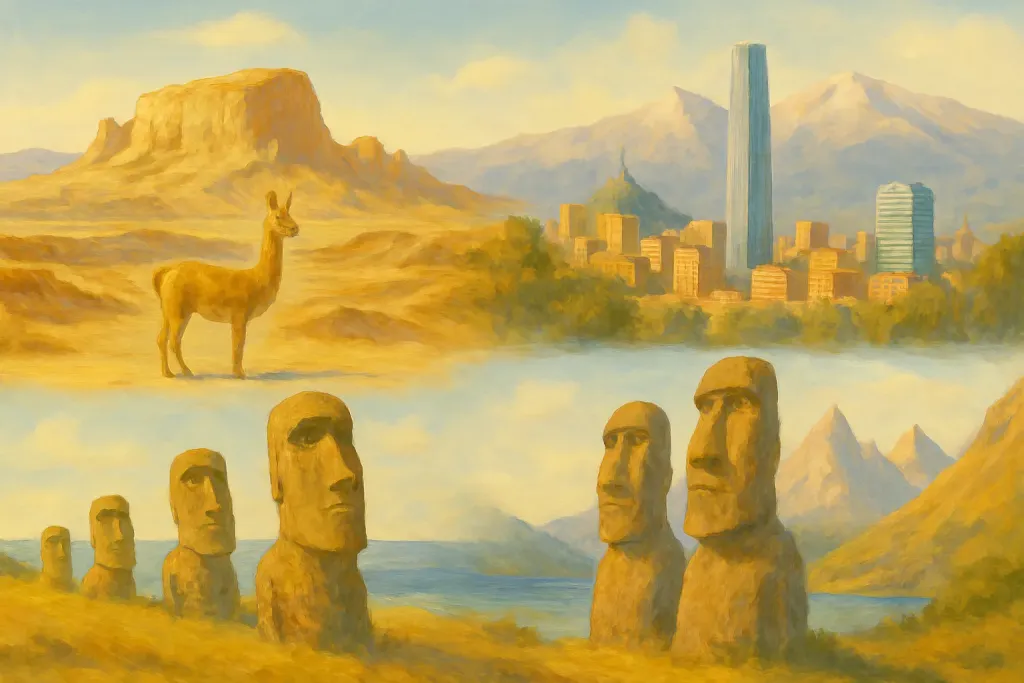
Chile is a unitary presidential republic in western South America, stretching approximately 4300 km from north to south along the Pacific coast. The country borders Peru, Bolivia, and Argentina, and also lays claim to territory in Antarctica. The capital is Santiago; major cities include Valparaiso, Concepción, and Antofagasta. The population is approximately 19,6 million; the official language is Spanish, and Mapudungun, Aymara, and Rapanui are spoken at the regional level. The currency is the Chilean peso. National symbols include the huemul deer and the Andean condor. The system of government consists of an elected president and a bicameral National Congress. Chile's economy is diversified, but relies on copper and lithium mining, agriculture, forestry, salmon farming, services, and a growing renewable energy sector. Land-based casinos operate under licenses, while online betting is still in the process of developing its regulatory framework. The country's armed forces are professional and focused on defense and peacekeeping.
History
Long before the arrival of Europeans, diverse cultures flourished across Chile, stretching from northern to southern latitudes. In the far north, Atacameño communities created irrigated oases on the edge of the desert and conducted trade across the Andes. In the central and southern regions, the Mapuche and related peoples played a significant role, creating stable social structures and distinguished by a steadfast desire for autonomy. In the late 15th century, the Inca Empire extended its influence to the far north but was unable to subjugate the core Mapuche lands. In the 1540s, the Spanish, led by Pedro de Valdivia, founded Santiago and other cities, establishing the Captaincy General of Chile. Colonial Chile was a frontier society, defined by the Arauco War—a centuries-long conflict and negotiation process with the Mapuche—and its relative economic marginality compared to Peru. The colony's economy was based on wheat cultivation, livestock raising, and small-scale mining, with the southern territories remaining largely unconquered.
The struggle for independence began in 1810 with the establishment of a local junta amid the upheaval of the Napoleonic Wars. Following royalist counteroffensives, the patriot cause prevailed under the joint leadership of Bernardo O'Higgins and José de San Martín, leading to independence in 1818. Throughout the 19th century, the young republic consolidated its position, centralizing state institutions and expanding education and infrastructure. During the War of the Pacific (1879–1884) against Peru and Bolivia, Chile gained control of the saltpeter-rich northern territories, radically altering public finances and stimulating immigration and modernization. The civil war of 1891 ushered in a transition to a parliamentary republic and ushered in decades of intense political struggle between oligarchic factions, as well as the rise of social movements among miners, dockworkers, and urban workers.
In the 20th century, import-substitution industrialization policies promoted the development of manufacturing, and copper gained enormous importance on the global market. By the late 1960s, political polarization in the country had intensified. In 1970, Salvador Allende became the world's first democratically elected Marxist president; he implemented profound reforms amid economic instability and external pressure. On September 11, 1973, a military coup led by General Augusto Pinochet overthrew the Allende government. A harsh dictatorship was established, characterized by human rights violations, market reforms, and the adoption of a new constitution in 1980. A plebiscite in 1988 ended the dictatorship, and democracy was restored in the country in 1990 with the accession to power of President Patricio Aylwin. Successive center-left and center-right governments expanded social support measures and deepened integration into the global market economy. Chile successfully overcame a number of crises and natural disasters, including the devastating 8,8-magnitude earthquake in the Maule region (2010) and the dramatic, internationally watched rescue operation of miners in Copiapó (2010).
From the student protests of 2011 to the widespread social unrest of 2019, Chile faced demands for social justice, pension reform, and a renewed constitution. A constitutional process was launched in 2020, but proposed drafts of a new constitution were rejected in referendums in 2022 and 2023, leaving debate on reform ongoing. In 2022, Gabriel Boric assumed the presidency, marking a generational change and a commitment to a more inclusive development model. Chile remains a democratic state with a high level of institutional capacity—by regional standards—as it addresses challenges such as overcoming inequality, transitioning to a sustainable economy, ensuring the rights of indigenous peoples, and adapting to climate change.
Industrials
Mining plays a leading role in value creation and exports. Chile is the world's largest copper producer, home to Codelco and such giant mines as Escondida. Lithium extraction from brines in the Atacama Desert provides raw materials for a rapidly growing battery materials sector. Other important industries include forestry and pulp production, salmon farming in the south, fruit and wine exports, and services. Well-known Chilean brands and companies include wine producer Concha y Toro, LATAM Airlines, retailer Falabella, forestry giants Arauco and CMPC, lithium company SQM, food technology startup NotCo, and engineering company Crystal Lagoons. The country's industrial achievements include world leadership in copper mining, a leading position in salmon production, and the operation of industrial-scale solar power plants in the Atacama Desert, which utilize some of the world's highest solar insolation rates.
Flora and fauna
Chile's geographic isolation results in a high level of endemism. Iconic species include the huemul deer. Chile is a unitary presidential republic in western South America, stretching approximately 4300 km from north to south along the Pacific coast. The country borders Peru, Bolivia, and Argentina and also lays claim to territory in Antarctica. The capital is Santiago; major cities include Valparaiso, Concepción, and Antofagasta. The population is approximately 19,6 million; the official language is Spanish, and Mapudungun, Aymara, and Rapanui are also spoken regionally. The currency is the Chilean peso. National symbols include the huemul deer and the Andean condor. The system of government consists of an elected president and a bicameral National Congress. Chile's economy is diversified, but relies on copper and lithium mining, agriculture and forestry, salmon farming, services, and a growing renewable energy sector. Land-based casinos operate under licenses, while the online betting industry is still in the process of developing a regulatory framework. The country's armed forces are professional and focused on defense and peacekeeping.
History
Long before the arrival of Europeans, diverse cultures flourished across Chile, stretching from northern to southern latitudes. In the far north, Atacameño communities created irrigated oases on the edge of the desert and conducted trade across the Andes. In the central and southern regions, the Mapuche and related peoples played a significant role, creating stable social structures and distinguished by a steadfast desire for autonomy. In the late 15th century, the Inca Empire extended its influence to the far north but was unable to subjugate the core Mapuche lands. In the 1540s, the Spanish, led by Pedro de Valdivia, founded Santiago and other cities, establishing the Captaincy General of Chile. Colonial Chile was a frontier society, defined by the Arauco War—a centuries-long conflict and negotiation process with the Mapuche—and its relative economic marginality compared to Peru. The colony's economy was based on wheat cultivation, livestock raising, and small-scale mining, with the southern territories remaining largely unconquered.
The struggle for independence began in 1810 with the establishment of a local junta amid the upheaval of the Napoleonic Wars. Following royalist counteroffensives, the patriot cause prevailed under the joint leadership of Bernardo O'Higgins and José de San Martín, leading to independence in 1818. Throughout the 19th century, the young republic consolidated its position, centralizing state institutions and expanding education and infrastructure. During the War of the Pacific (1879–1884) against Peru and Bolivia, Chile gained control of the saltpeter-rich northern territories, radically altering public finances and stimulating immigration and modernization. The civil war of 1891 ushered in a transition to a parliamentary republic and ushered in decades of intense political struggle between oligarchic factions, as well as the rise of social movements among miners, dockworkers, and urban workers.
In the 20th century, import-substitution industrialization policies promoted the development of manufacturing, and copper gained enormous importance on the global market. By the late 1960s, political polarization in the country had intensified. In 1970, Salvador Allende became the world's first democratically elected Marxist president; he implemented profound reforms amid economic instability and external pressure. On September 11, 1973, a military coup led by General Augusto Pinochet overthrew the Allende government. A harsh dictatorship was established, characterized by human rights violations, market reforms, and the adoption of a new constitution in 1980. A plebiscite in 1988 ended the dictatorship, and democracy was restored in the country in 1990 with the accession to power of President Patricio Aylwin. Successive center-left and center-right governments expanded social support measures and deepened integration into the global market economy. Chile successfully overcame a number of crises and natural disasters, including the devastating 8,8-magnitude earthquake in the Maule region (2010) and the dramatic, internationally watched rescue operation of miners in Copiapó (2010).
From the student protests of 2011 to the widespread social unrest of 2019, Chile faced demands for social justice, pension reform, and a renewed constitution. A constitutional process was launched in 2020, but proposed drafts of a new constitution were rejected in referendums in 2022 and 2023, leaving debate on reform ongoing. In 2022, Gabriel Boric assumed the presidency, marking a generational change and a commitment to a more inclusive development model. Chile remains a democratic state with a high level of institutional capacity—by regional standards—as it addresses challenges such as overcoming inequality, transitioning to a sustainable economy, ensuring the rights of indigenous peoples, and adapting to climate change.
Industrials
Mining plays a leading role in value creation and exports. Chile is the world's largest copper producer, home to Codelco and such giant mines as Escondida. Lithium extraction from brines in the Atacama Desert provides raw materials for a rapidly growing battery materials sector. Other important industries include forestry and pulp production, salmon farming in the south, fruit and wine exports, and services. Well-known Chilean brands and companies include wine producer Concha y Toro, LATAM Airlines, retailer Falabella, forestry giants Arauco and CMPC, lithium company SQM, food technology startup NotCo, and engineering company Crystal Lagoons. The country's industrial achievements include world leadership in copper mining, a leading position in salmon production, and the operation of industrial-scale solar power plants in the Atacama Desert, which utilize some of the world's highest solar insolation rates.
Flora and fauna
Chile's geographic isolation results in a high level of endemism. Iconic species include the huemul deer. Chile is a unitary presidential republic in western South America, stretching approximately 4300 km from north to south along the Pacific coast. The country borders Peru, Bolivia, and Argentina and also lays claim to territory in Antarctica. The capital is Santiago; major cities include Valparaiso, Concepción, and Antofagasta. The population is approximately 19,6 million; the official language is Spanish, and Mapudungun, Aymara, and Rapanui are also spoken regionally. The currency is the Chilean peso. National symbols include the huemul deer and the Andean condor. The system of government consists of an elected president and a bicameral National Congress. Chile's economy is diversified, but relies on copper and lithium mining, agriculture and forestry, salmon farming, services, and a growing renewable energy sector. Land-based casinos operate under licenses, while the online betting industry is still in the process of developing a regulatory framework. The country's armed forces are professional and focused on defense and peacekeeping.
History
Long before the arrival of Europeans, diverse cultures flourished across Chile, stretching from northern to southern latitudes. In the far north, Atacameño communities created irrigated oases on the edge of the desert and conducted trade across the Andes. In the central and southern regions, the Mapuche and related peoples played a significant role, creating stable social structures and distinguished by a steadfast desire for autonomy. In the late 15th century, the Inca Empire extended its influence to the far north but was unable to subjugate the core Mapuche lands. In the 1540s, the Spanish, led by Pedro de Valdivia, founded Santiago and other cities, establishing the Captaincy General of Chile. Colonial Chile was a frontier society, defined by the Arauco War—a centuries-long conflict and negotiation process with the Mapuche—and its relative economic marginality compared to Peru. The colony's economy was based on wheat cultivation, livestock raising, and small-scale mining, with the southern territories remaining largely unconquered.
The struggle for independence began in 1810 with the establishment of a local junta amid the upheaval of the Napoleonic Wars. Following royalist counteroffensives, the patriot cause prevailed under the joint leadership of Bernardo O'Higgins and José de San Martín, leading to independence in 1818. Throughout the 19th century, the young republic consolidated its position, centralizing state institutions and expanding education and infrastructure. During the War of the Pacific (1879–1884) against Peru and Bolivia, Chile gained control of the saltpeter-rich northern territories, radically altering public finances and stimulating immigration and modernization. The civil war of 1891 ushered in a transition to a parliamentary republic and ushered in decades of intense political struggle between oligarchic factions, as well as the rise of social movements among miners, dockworkers, and urban workers.
In the 20th century, import-substitution industrialization policies promoted the development of manufacturing, and copper gained enormous importance on the global market. By the late 1960s, political polarization in the country had intensified. In 1970, Salvador Allende became the world's first democratically elected Marxist president; he implemented profound reforms amid economic instability and external pressure. On September 11, 1973, a military coup led by General Augusto Pinochet overthrew the Allende government. A harsh dictatorship was established, characterized by human rights violations, market reforms, and the adoption of a new constitution in 1980. A plebiscite in 1988 ended the dictatorship, and democracy was restored in the country in 1990 with the accession to power of President Patricio Aylwin. Successive center-left and center-right governments expanded social support measures and deepened integration into the global market economy. Chile successfully overcame a number of crises and natural disasters, including the devastating 8,8-magnitude earthquake in the Maule region (2010) and the dramatic, internationally watched rescue operation of miners in Copiapó (2010).
From the student protests of 2011 to the widespread social unrest of 2019, Chile faced demands for social justice, pension reform, and a renewed constitution. A constitutional process was launched in 2020, but proposed drafts of a new constitution were rejected in referendums in 2022 and 2023, leaving debate on reform ongoing. In 2022, Gabriel Boric assumed the presidency, marking a generational change and a commitment to a more inclusive development model. Chile remains a democratic state with a high level of institutional capacity—by regional standards—as it addresses challenges such as overcoming inequality, transitioning to a sustainable economy, ensuring the rights of indigenous peoples, and adapting to climate change.
Industrials
Mining plays a leading role in value creation and exports. Chile is the world's largest copper producer, home to Codelco and such giant mines as Escondida. Lithium extraction from brines in the Atacama Desert provides raw materials for a rapidly growing battery materials sector. Other important industries include forestry and pulp production, salmon farming in the south, fruit and wine exports, and services. Well-known Chilean brands and companies include wine producer Concha y Toro, LATAM Airlines, retailer Falabella, forestry giants Arauco and CMPC, lithium company SQM, food technology startup NotCo, and engineering company Crystal Lagoons. The country's industrial achievements include world leadership in copper mining, a leading position in salmon production, and the operation of industrial-scale solar power plants in the Atacama Desert, which utilize some of the world's highest solar insolation rates.
Flora and fauna
Chile's geographic isolation results in a high level of endemism. Iconic species include the huemul deer. Chile is home to the pudú, Andean condor, Magellanic penguin, and the endangered Darwin's frog. Marine life thrives along the Humboldt Current, home to sea lions, dolphins, and abundant fisheries. Flora ranges from Atacama cacti and desert flowers to central Mediterranean sclerophyll forests and the ancient Araucaria araucana of the south. Juan Fernández and Rapa Nui are home to unique species under strict protection. Many species are listed on national red lists and the IUCN register. The export of native wildlife and some plants is restricted and controlled in accordance with CITES and national legislation.
Religion and race
Chile is a country with a diverse religious population, historically predominantly Catholic, with significant Protestant and Evangelical communities, as well as a large and growing secular population. Indigenous peoples make up approximately one-tenth of the population, led by the Mapuche, with Aymara, Diaguita, Rapanui, and others also present. Traditions combine Catholic holidays, Gospel services, and traditional indigenous rituals, such as Ve Tripantu, the Mapuche New Year. Public life is secular, and interfaith coexistence is the norm.
Wars and conflicts
Major conflicts include the Arauco War, the War of the Pacific, and the Civil War of 1891. A dispute with Argentina over the Beagle Channel in the late 20th century was settled diplomatically in 1984. Today, Chile is not involved in external wars and contributes to peacekeeping operations. Internal tensions include periodic conflicts over land and rights in the south, which the state resolves through policing and dialogue. The risk of terrorism is low, although there have been isolated incidents. War cemeteries and memorials exist throughout the country, and the memory of the victims of the dictatorship is institutionalized.
Standard of living
Chile ranks highly in Latin America in human development, competitiveness, and governance. Inequality remains above the OECD average, but poverty has declined significantly in recent decades. Perceptions of corruption are relatively low in the region, although accountability and campaign finance remain challenges for the population. City services are reliable, and digital adoption is widespread.
Medicine
The healthcare system is a combination of public and private sectors. Major cities have modern hospitals affiliated with the public Fonasa system and the private Isapre network. Pharmacies (such as Cruz Verde and Ahumada) are ubiquitous and often open late. Tap water is potable in many urban areas, but travelers with sensitive stomachs are advised to choose bottled water, especially in the north and rural areas. Important practical considerations include sun protection, high altitude (in the Atacama Desert), and earthquake preparedness. Travelers are advised to get standard vaccinations, including hepatitis A vaccination.
Sport
Football is the most popular sport; the Chilean national team won the Copa América in 2015 and 2016. Chilean rodeo is considered the national sport. Tennis stars include legends such as Marcelo Rios and Fernando González. Alpine skiing and snowboarding are booming in the resorts of the Central Andes, while trail running, surfing, mountaineering, and fly fishing attract many enthusiasts. Santiago hosted the 2023 Pan American Games.
Holidays
Major public holidays include: New Year's Day (January 1), Good Friday and Easter (dates vary), Labor Day (May 1), Navy Day (May 21), Saints Peter and Paul's Day (June 29), Our Lady of Mount Carmel Day (July 16), Assumption Day (August 15), National Indigenous Peoples' Day (near the summer solstice in June), Independence Day (September 18), Army Day (September 19), Columbus Day (October 12), Reformation Day (near October 31), Immaculate Conception (December 8), and Christmas (December 25). Dates may be moved to create long weekends.
Traditions
September festivities include the cueca dance, asado cooking, and festivities in ramadas (traditional festive tents). "Onces"—an evening tea with bread and sweets—serves as a bridge between lunch and late dinner. Greetings are politely accepted at markets. On the island of Rapa Nui, touching the moai statues is prohibited. In Mapuche areas, permission to take photographs must be sought and the customary etiquette observed. In restaurants, a 10% tip is customary.
Interesting Facts
The Atacama Desert is one of the driest places on Earth and home to the ALMA radio observatory. Subduction in Chile frequently causes powerful earthquakes. The moai statues on Easter Island are a marvel of Polynesian culture. Nobel Prize winners Gabriela Mistral and Pablo Neruda are Chilean. The 2010 rescue operation at the Copiapó mine inspired the film "The 33." Cable cars and street art define the unique character of Valparaiso, nestled in the hills. The Patagonian ice fields are the largest in the Southern Hemisphere outside the polar regions.
Money
The Chilean peso (CLP) is the national currency. Bank cards are widely accepted, including those with contactless payment support. There are many ATMs in cities. The approximate exchange rate is 900 to 1000 CLP per US dollar, but the rate fluctuates daily. It's best to exchange currency at banks or official currency exchange offices (casas de cambio), rather than at airports. Foreign tourists are often exempt from paying the 19% VAT when paying with foreign bank cards or in US dollars (upon presentation of a passport and immigration card). It's customary to leave a 10% tip in restaurants. When visiting markets and rural areas, it's a good idea to carry cash (in small denominations).
Household issues
The electrical voltage is 220 V, 50 Hz; sockets are type C and L. The main mobile phone providers are Entel, Movistar, and WOM. Chile is home to the pudú, the Andean condor, the Magellanic penguin, and the endangered Darwin's frog. Marine life thrives along the Humboldt Current, with sea lions, dolphins, and abundant fisheries. Flora ranges from Atacama cacti and desert flowers to central Mediterranean sclerophyll forests and the ancient Araucaria araucana in the south. Juan Fernández and Rapa Nui are home to unique species under strict protection. Many species are listed on national red lists and the IUCN register. The export of native wildlife and some plants is limited and controlled in accordance with CITES and national legislation.
Religion and race
Chile is a country with a diverse religious population, historically predominantly Catholic, with significant Protestant and Evangelical communities, as well as a large and growing secular population. Indigenous peoples make up approximately one-tenth of the population, led by the Mapuche, with Aymara, Diaguita, Rapanui, and others also present. Traditions combine Catholic holidays, Gospel services, and traditional indigenous rituals, such as Ve Tripantu, the Mapuche New Year. Public life is secular, and interfaith coexistence is the norm.
Wars and conflicts
Major conflicts include the Arauco War, the War of the Pacific, and the Civil War of 1891. A dispute with Argentina over the Beagle Channel in the late 20th century was settled diplomatically in 1984. Today, Chile is not involved in external wars and contributes to peacekeeping operations. Internal tensions include periodic conflicts over land and rights in the south, which the state resolves through policing and dialogue. The risk of terrorism is low, although there have been isolated incidents. War cemeteries and memorials exist throughout the country, and the memory of the victims of the dictatorship is institutionalized.
Standard of living
Chile ranks highly in Latin America in human development, competitiveness, and governance. Inequality remains above the OECD average, but poverty has declined significantly in recent decades. Perceptions of corruption are relatively low in the region, although accountability and campaign finance remain challenges for the population. City services are reliable, and digital adoption is widespread.
Medicine
The healthcare system is a combination of public and private sectors. Major cities have modern hospitals affiliated with the public Fonasa system and the private Isapre network. Pharmacies (such as Cruz Verde and Ahumada) are ubiquitous and often open late. Tap water is potable in many urban areas, but travelers with sensitive stomachs are advised to choose bottled water, especially in the north and rural areas. Important practical considerations include sun protection, high altitude (in the Atacama Desert), and earthquake preparedness. Travelers are advised to get standard vaccinations, including hepatitis A vaccination.
Sport
Football is the most popular sport; the Chilean national team won the Copa América in 2015 and 2016. Chilean rodeo is considered the national sport. Tennis stars include legends such as Marcelo Rios and Fernando González. Alpine skiing and snowboarding are booming in the resorts of the Central Andes, while trail running, surfing, mountaineering, and fly fishing attract many enthusiasts. Santiago hosted the 2023 Pan American Games.
Holidays
Major public holidays include: New Year's Day (January 1), Good Friday and Easter (dates vary), Labor Day (May 1), Navy Day (May 21), Saints Peter and Paul's Day (June 29), Our Lady of Mount Carmel Day (July 16), Assumption Day (August 15), National Indigenous Peoples' Day (near the summer solstice in June), Independence Day (September 18), Army Day (September 19), Columbus Day (October 12), Reformation Day (near October 31), Immaculate Conception (December 8), and Christmas (December 25). Dates may be moved to create long weekends.
Traditions
September festivities include the cueca dance, asado cooking, and festivities in ramadas (traditional festive tents). "Onces"—an evening tea with bread and sweets—serves as a bridge between lunch and late dinner. Greetings are politely accepted at markets. On the island of Rapa Nui, touching the moai statues is prohibited. In Mapuche areas, permission to take photographs must be sought and the customary etiquette observed. In restaurants, a 10% tip is customary.
Interesting Facts
The Atacama Desert is one of the driest places on Earth and home to the ALMA radio observatory. Subduction in Chile frequently causes powerful earthquakes. The moai statues on Easter Island are a marvel of Polynesian culture. Nobel Prize winners Gabriela Mistral and Pablo Neruda are Chilean. The 2010 rescue operation at the Copiapó mine inspired the film "The 33." Cable cars and street art define the unique character of Valparaiso, nestled in the hills. The Patagonian ice fields are the largest in the Southern Hemisphere outside the polar regions.
Money
The Chilean peso (CLP) is the national currency. Bank cards are widely accepted, including those with contactless payment support. There are many ATMs in cities. The approximate exchange rate is 900 to 1000 CLP per US dollar, but the rate fluctuates daily. It's best to exchange currency at banks or official currency exchange offices (casas de cambio), rather than at airports. Foreign tourists are often exempt from paying the 19% VAT when paying with foreign bank cards or in US dollars (upon presentation of a passport and immigration card). It's customary to leave a 10% tip in restaurants. When visiting markets and rural areas, it's a good idea to carry cash (in small denominations).
Household issues
The electrical voltage is 220 V, 50 Hz; sockets are type C and L. The main mobile phone providers are Entel, Movistar, WOM…, and Claro. Prepaid SIM cards are easily purchased with a passport. Smoking is prohibited in enclosed public spaces and in some open areas, such as school grounds. Tap water quality varies by region.
Apparel
Smart casual is the norm in cities. Due to the differences in latitude and altitude, layering is essential. For Patagonia, pack windproof and waterproof clothing. For the Atacama Desert, bring sunscreen and warm layers for the night. When visiting churches and participating in indigenous ceremonies, a dress code is required, which requires a modest and respectful appearance. Open-toed shoes are acceptable in cities, but sturdy, durable footwear is recommended for hiking in the wilderness.
Tourism
To fully explore the country, plan a trip lasting at least 10-14 days. The classic itinerary includes Santiago and Valparaiso, the central wine valleys, the Atacama Desert (geysers and stargazing), and the Lake District (volcanoes and forests). If you have more time, add a visit to Torres del Paine National Park and the Patagonian fjords or the Chiloé Archipelago. A trip to Easter Island requires a separate 4-5-day trip from Santiago. Public safety is high by regional standards, but basic caution should be observed in cities. Distances are long, so combine flights with intercity bus travel or a rental car to explore specific areas. Trips to Patagonia during peak season should be booked several months in advance.
Types of tourism
Cultural city breaks, wine tourism, desert and astrotourism tours, trekking and mountaineering, alpine skiing, surfing and kitesurfing, expeditions to Patagonia, bird and wildlife watching, indigenous culture experiences, gastronomic routes, fjord cruises, and archaeological tours (Easter Island/Rapa Nui and the north of the country).
List of attractions
– Torres del Paine National Park – granite towers, glaciers, trekking along the “W” route, Patagonia.
– San Pedro de Atacama and surroundings – Moon Valley (Valle de la Luna), El Tatio geysers, salt flats, stargazing.
– Rapa Nui National Park (Easter Island) – moai statues, ahu platforms, Polynesian culture (UNESCO site).
– Valparaiso's historic quarter – funiculars, murals, port heritage (a UNESCO site). – Santiago – Plaza de Armas, Cerro San Cristobal, museums, markets.
– Chiloé Churches – Wooden Churches, UNESCO World Heritage Site, and Island Culture – UNESCO World Heritage Site.
– Humberstone and Santa Laura – ghost towns in the north where nitrates were mined – UNESCO.
– Lauca National Park – high-mountain lakes, vicuñas, views of volcanoes.
– Lake District – volcanoes Villarrica and Osorno, lakes and hot springs.
– Elqui Valley – pisco distilleries and dark-sky observatories.
– Sewell Mining Town – Historic Andean Working Town – UNESCO.
– Carretera Austral is a picturesque highway through fjords, forests, and marble caves.
List of non-tourist attractions
– Caleta Portales Fish Market in Valparaiso – morning seafood auctions and local eateries.
– The areas of the cultural center Estación Mapocho – everyday life in Santiago outside the center.
– Cemeteries where nitrates are grown and little-visited offices away from the main roads in Tarapaca.
– Small vineyards in Maule and Itatá, specialising in traditional grape varieties.
– Active shipyards and warehouses from the saltpeter era in less busy ports.
Local kitchen
Expect empanadas de pino, pastel de choclo, cazuela stews, caldillo de congrio, choripan, asado, curanto de Chiloé, machas a la parmesan, seafood galore, and classic street dishes like completos. Desserts include cucuflis and mote con huesillo. World-class wines are represented by Cabernet, Carménère, Pinot Noir, and Sauvignon Blanc. Popular drinks include pisco, chicha, and terremoto. Lunch is served at midday, dinner is late, and lunch includes drinks that are usually missing for lunch. The standard tip is 10 percent of the cost. Street food is generally safe in busy and clean kiosks. In remote areas, check seafood safety regulations.
Why visit
Chile offers extraordinary diversity in one safe, efficient, and welcoming country. From deserts and stargazing spots to ice fields and Polynesian cultural heritage, this is a journey full of contrasts, made comfortable by its well-developed infrastructure.
Tourist safety
The risk of terrorist threats is low. Petty thefts do occur in crowded areas, so valuables should be protected and kept in hotel safes. There is a real risk of earthquakes and tsunamis along the coast, but clear signs are posted and warning systems are in place. Risks associated with natural factors are moderate, but include dangerous ocean currents (rip currents), altitude sickness, and rare encounters with venomous spiders, such as the Chilean recluse spider. High hygiene standards are maintained in cities. Emergency numbers: police - 133, ambulance - 131, fire department - 132, investigative police - 134. Respectful treatment of all groups is expected.
Level of tourism infrastructure
The main tourist centers offer a high level of service, with a wide selection of hotels and restaurants. English is widely spoken in tourism and business, but less so in rural areas. Electronic payments and online booking are widely used. Information desks and qualified guides are available in key tourist centers.
Rules of entry
Most travelers are allowed visa-free entry for up to 90 days (depending on citizenship). Passports must be valid for at least six months from the date of entry. Strict phytosanitary and veterinary regulations apply; the import of fresh fruits, seeds, and animal products is prohibited. Certain goods are often prohibited. Declare all items upon entry. Keep your entry receipt to obtain a VAT exemption at hotels. Before traveling, review the latest information on sanitary and visa requirements.
Transport
Domestic flights are a convenient way to cover long distances. Intercity buses are frequent and comfortable. Santiago has a unified metro and bus network, with payment via a preloaded card. Taxis are metered, and taxi apps are also widely available. Bus and train tickets can be purchased at train stations or online. Ferries connect the southern regions. Night buses are a practical and inexpensive option for long journeys.
car
To rent a car, you will need a passport, credit card, and a valid driver's license from your home country (an International Driving Permit is also recommended). Driving drives on the right-hand side of the road. Traffic jams are common in cities; rural roads are in good condition, but many are toll roads (Santiago has electronic toll-free systems that require a special pass or subsequent payment). Speed limits are generally 50 km/h (31 mph) in built-up areas, 100 km/h (62 mph) on rural roads, and 120 km/h (75 mph) on highways. The police are professional, and bribery is not tolerated. Laws against drunk driving are strict, with a minimal blood alcohol level. Speed cameras and radars are common. In Patagonia and the Andes, it is best to use vehicles with high ground clearance; be prepared for gravel roads, and in winter, bring snow chains when crossing mountain passes. Parking is regulated and often subject to a fee in city centers.
Silent mode
Quiet regulations in residential areas typically apply at night (often after 22:00 PM), but specific requirements vary by municipality and building code. Follow your community's rules.
Daily budget of a tourist
Budget option: 35,000–55,000 CLP per day (approx. 35–60 USD). Mid-range: 80,000–140,000 CLP (approx. 90–150 USD). Comfort level: from 180,000 CLP (from 200 USD). Costs are higher in Patagonia and Easter Island.
What is not recommended or prohibited
Do not bring undeclared fresh food into the country. Do not touch or climb moai or archaeological sites. Observe drone regulations, which require permits in urban and protected areas, and note the stricter restrictions on Rapa Nui. Avoid photographing military installations. Do not remove stones, shells, or artifacts from protected areas. Observe fire restrictions in parks.
Climate
Chile experiences extreme climates. The northern part of the country is extremely arid, with warm days and cold nights. Central Chile has a Mediterranean climate with rainy winters and dry, warm summers. The southern part is temperate and rainy, giving way to a subpolar climate in Patagonia with strong winds. The best time to visit varies depending on the region: the Atacama is suitable for a holiday year-round, the central valleys shine from September to May, the ski season lasts from June to September, and Patagonia from October to April.
Tips for tourists
Carry sunscreen and drink plenty of water, especially at altitude. Acclimatize to the Atacama to avoid tsunamis. Regular vaccinations, including the hepatitis A vaccine, are recommended. Learn a few Spanish phrases. Keep digital and paper copies of your documents. Register for a VAT-free hotel stay by paying with a foreign card and presenting your passport and entry card. Know earthquake safety rules: duck, cover, and hold on, and follow tsunami evacuation signs along the coast.